

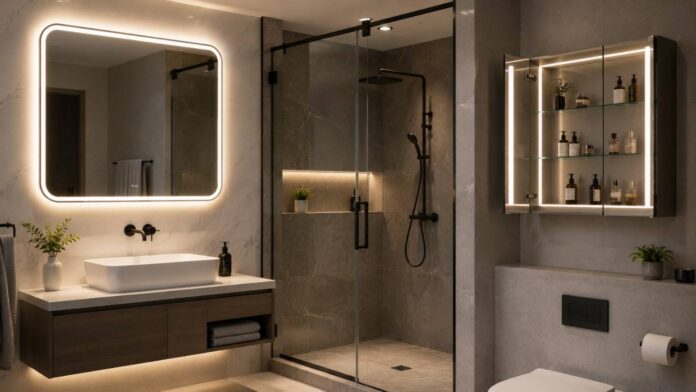

Most bathroom renovations budget for tile, fixtures, and a vanity, then treat the shower enclosure as an afterthought bolted on at the end. That’s backwards. Glass shower doors sit at eye level in a small room, which means they do more visual work than almost anything else in the bathroom, and the wrong choice is expensive to undo once it’s caulked into a tile job.
Frameless, semi-frameless, and framed differ in more than looks
Glass thickness and hardware weight both change with the category, and the differences matter more than the visual style alone.
- Framed doors use aluminum channels around the glass edges, typically 1/4 to 3/16 inch thick tempered glass, and cost the least of the three options
- Semi-frameless doors use heavier hardware at the hinges and handle but skip the full perimeter frame, usually paired with 3/8 inch glass
- Frameless doors rely on the glass thickness itself for rigidity, almost always 1/2 inch tempered glass, held by minimal clips and hinges
- Thicker glass keeps a frameless door from flexing or rattling when it closes, since there’s no metal frame doing that job instead
A frameless door on thin glass will eventually show it, usually as a door that doesn’t sit flush or clicks against its own hardware.
Glass type and coating decide how much cleaning you’ll actually do
All shower glass sold for enclosures should be tempered, meaning it’s heat-treated to shatter into small, rounded pieces rather than sharp shards if it breaks. That part isn’t optional and any reputable seller confirms it on the spec sheet.
- Clear glass shows every water spot, which matters more with hard water than most people expect going in
- A factory-applied protective coating, often marketed under names like ClearShield or EnduroShield, resists mineral buildup and cuts down on the squeegee habit most people never actually keep up with
- Frosted, rain, or textured glass hides water spots better day to day but also hides grime for longer between cleanings, so it trades one maintenance problem for another
- Low-iron glass costs more and looks slightly clearer than standard glass, which shows as a faint green tint along the edges on thicker panels
None of these choices are wrong. They’re trade-offs between upfront cost, ongoing cleaning, and how much you actually care about a slightly green edge nobody else will notice.
Hardware finish matters more in a wet room than anywhere else in the house
- Chrome is the least expensive finish and shows water spots the most visibly of the common options
- Brushed nickel hides water spots better than polished chrome and has become the default choice in most new installs
- Matte black and brass finishes cost more and can show hard water etching over time if the coating isn’t rated for constant moisture
- Whatever finish gets chosen for the shower door hardware should match the faucet and showerhead finish. A mismatch reads as an oversight, not a deliberate choice
Sizing, swing direction, and clearance are decided before the glass is even ordered
- A standard shower opening runs 56 to 60 inches for a sliding door and needs the full width measured at three heights, since older tile jobs are rarely perfectly square
- Swing doors need floor clearance to open fully without hitting a toilet or vanity, typically at least 24 inches of clear floor space in the swing path
- Pivot doors save floor space compared to a hinged swing door and work well in a tighter bathroom layout
- Custom sizing (anything outside stock panel dimensions) adds meaningfully to both cost and lead time, often several weeks longer than a stock configuration
Getting an accurate measurement before ordering avoids the single most common and most expensive mistake in this category: a custom panel cut to a slightly wrong opening.
Installation isn’t always a weekend DIY project
A tile shower base and walls that are out of square by more than about 1/4 inch over the width of the opening make a clean glass install considerably harder, sometimes impossible without shimming that shows.
- Frameless doors are less forgiving of an out-of-square opening than framed doors, since there’s no metal channel to hide small gaps
- Anchoring hinges and clips into tile requires drilling through glazed tile without cracking it, which is where a lot of otherwise capable DIY installs go wrong
- A detailed installation guide helps, and free engineer support by phone catches the measurement mistakes before the glass is cut rather than after
- Silicone caulking around the base and walls needs a full cure time before the first shower, usually 24 hours, even though it looks dry much sooner
Sliding, hinged, and neo-angle configurations solve different layout problems
The frame style is one decision. The door configuration is a separate one, and it’s driven mostly by the bathroom’s floor plan rather than personal taste.
- Sliding doors work well in a standard alcove shower where a hinged door would need floor clearance the room doesn’t have; the trade-off is a track that collects hair and soap scum along the bottom rail
- Hinged doors swing open like a regular door and are easier to clean since there’s no track, but they need that clear floor space in front of the opening
- Neo-angle configurations cut across a corner at an angle, which reclaims usable floor space in a small bathroom at the cost of a more complex, more expensive glass cut
- A single fixed panel with no door at all works for a walk-in shower with no curb, though it leaves more of the opening exposed to spray than any of the enclosed options
Bathrooms under about 40 square feet usually do better with a pivot or neo-angle setup than a full sliding enclosure, simply because the sliding track needs wall space on both sides to operate.
Where the extra cost actually goes
Two glass doors that look nearly identical in a showroom can be several hundred dollars apart, and the difference rarely shows up until the door has been in daily use for a year or two.
- Hinge quality: budget hinges wear loose faster and eventually let the door sag slightly at the handle side, while heavier cast hinges hold their position for years longer
- Glass clarity: standard green-tinted glass costs less than low-iron glass, and the difference is most visible on thicker frameless panels viewed edge-on
- Coating durability: a factory coating rated for five years of hard water exposure costs more upfront than one rated for one or two years, but replaces the recurring cost of specialty cleaners
- Custom fabrication: any panel cut outside a manufacturer’s stock sizes adds both cost and lead time, and small measurement errors on a custom order are far more expensive to fix than on a stock panel
None of this means the priciest option is automatically worth it. A guest bathroom that sees occasional use doesn’t need the same coating or hinge grade as a primary shower used twice a day.
Where buyers get it wrong most often
- Ordering based on a rough tape measurement instead of measuring at the top, middle, and bottom of the opening
- Choosing frameless glass for an older, visibly out-of-square opening where a framed door would hide the gaps better
- Skipping the protective coating to save money, then dealing with permanent hard water etching within a year or two
- Picking hardware finish based on the door alone, without checking it against the faucet already installed
A short note on upkeep
A daily squeegee pass takes under a minute and does more for how a glass door looks after several years of use than any coating on its own. Hard water stains that sit for months become mineral deposits that ordinary glass cleaner won’t touch, at which point it’s a specialty hard water remover or, in bad cases, professional restoration. Coated glass buys time against that outcome. It doesn’t eliminate the need to wipe the glass down now and then.
None of this is complicated once the basics are in front of you: get an accurate measurement, pick a glass thickness that matches the frame style, and match the hardware finish to what’s already in the room. Sites like Allsumhome list glass thickness and coating details directly on each shower door’s product page, which is worth checking before anything else on a fixture that’s difficult and expensive to replace once it’s sealed in.